
News
The ASAM Criteria, 4th Edition (Adults)
Date: 05/11/26
Thank you for your continued partnership with Sunflower Health Plan. We continually review and update our payment and utilization policies to align with industry standards and support the best possible experience for our members. We are writing to inform you of an update to the ASAM Criteria currently used for substance use disorder (SUD) admissions (substance abuse/chemical dependency). Effective June 21, 2026, The ASAM Criteria, Fourth Edition, will be the medical necessity tool used to assess SUD admissions for all Ambetter providers requesting services for adult members. Child and adolescent requests will continue to utilize The ASAM Criteria, Third Edition.
What is The ASAM Criteria?
The ASAM Criteria is the most widely used and comprehensive set of standards for the placement, continued service, and transfer of patients with addiction and co-occurring conditions. Formerly known as the ASAM Patient Placement Criteria, The ASAM Criteria is the result of a collaboration that began in the 1980s to define a national set of criteria for providing outcome-oriented, results-based care in the treatment of addiction. Many states across the country use The ASAM Criteria as the foundation of efforts to improve the addiction treatment system.
Level of care recommendations and treatment plans are developed based on multidimensional patient assessments that consider the patient’s biomedical, psychological, and social needs.
What’s new in The ASAM Criteria, Fourth Edition?
Core Components of The ASAM Criteria
The ASAM Criteria standards include three core components that work in tandem when making level of care recommendations. As a patient enters addiction treatment an ASAM Criteria Level of Care Assessment is used to identify the patient’s clinical needs. The results of the assessment are applied to the Dimensional Admission Criteria to determine the recommended level of care.
The ASAM Criteria also define standards for the different levels of care across the continuum, describing the setting, staffing, service intensity, and other core elements at each level of care.
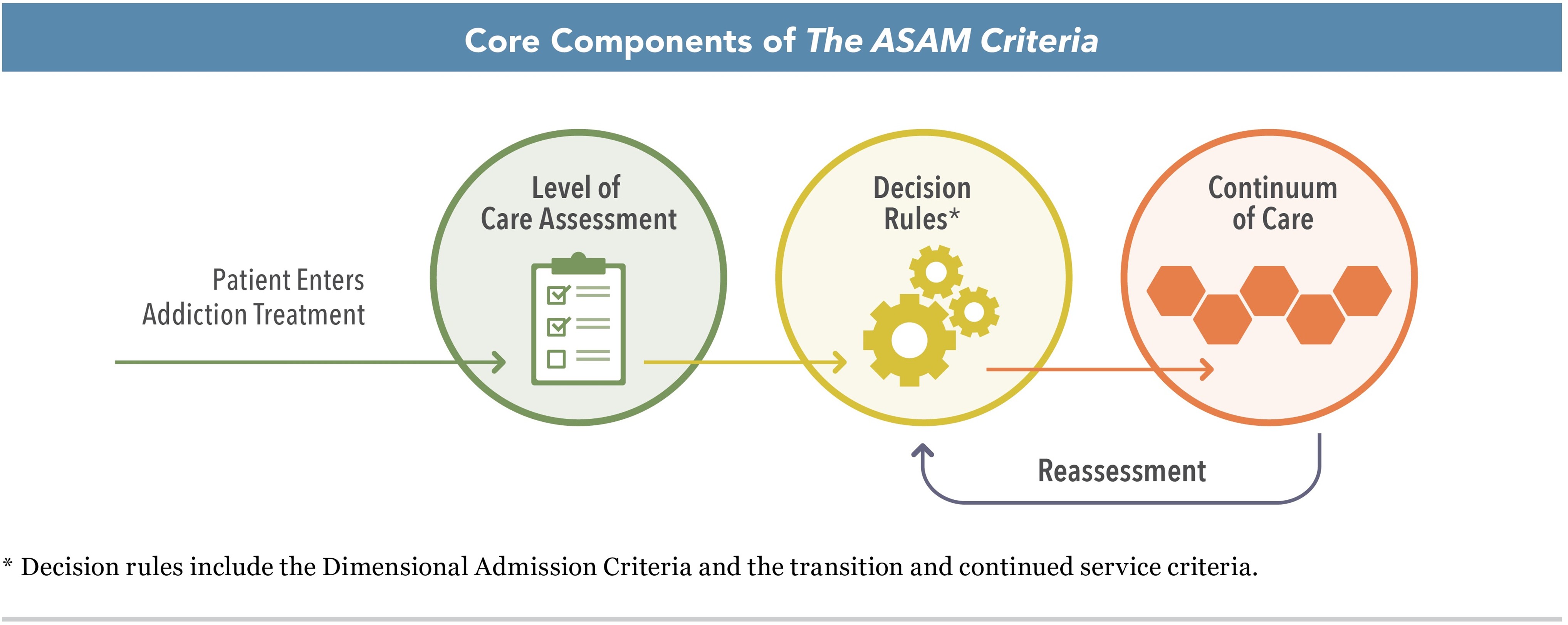
As a patient moves through treatment, they are regularly reassessed. The transition and continued service criteria are applied to determine if the patient is ready to move to a less intensive level of care, requires a more intensive level of care, or should continue at the current level of care.
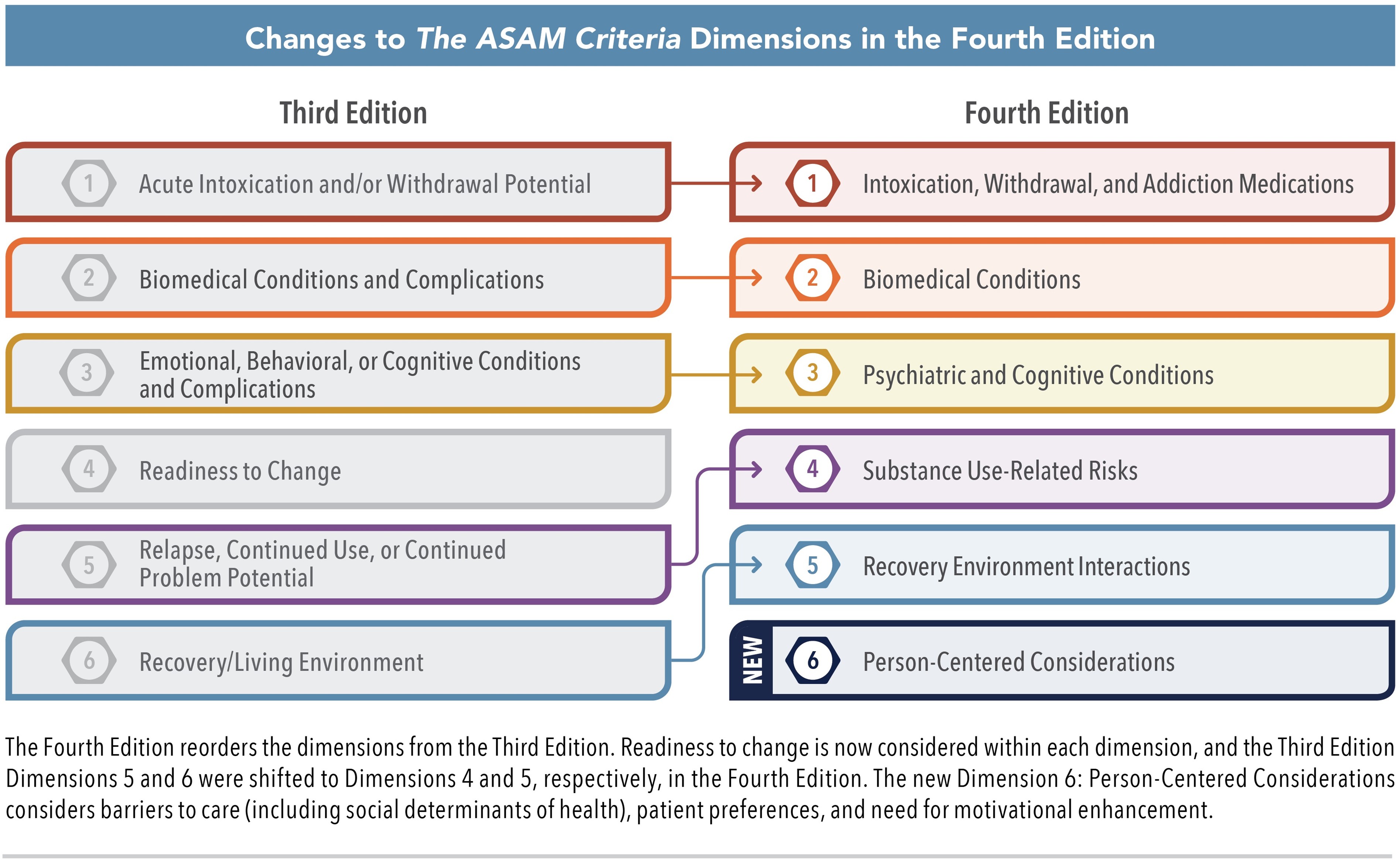
Updated Six Dimensions
The six dimensions of The ASAM Criteria were updated in the Fourth Edition. The Third Edition’s Dimension 4: Readiness to Change does not contribute independently to the recommended level of care; rather, it impacts clinical judgments related to risks in other dimensions and influences the services that should be delivered at any level of care and should be carefully considered in treatment planning.
The Fourth Edition reorders the dimensions such that consideration of readiness to change is integrated across dimensions and replaced by a new dimension, Dimension 6: Person-Centered Considerations. This new dimension considers barriers to care, including social determinants of health (SDOH)—patient preferences, and the need for motivational enhancement. The Fourth Edition also simplifies and updates dimension names to reflect the field’s evolving terminology and facilitate effective dissemination of these standards.
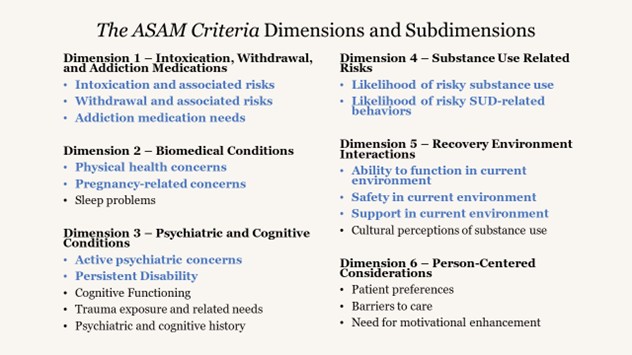
Newly Defined Subdimensions
The Fourth Edition describes subdimensions, reflecting core actionable factors, that should be assessed within each dimension. During the Level of Care Assessment, the subdimensions in bold and blue inform level of care recommendations and initial treatment for immediate needs; however, all subdimensions are considered for treatment planning purposes. Dimensions 1 through 5 are used to develop a level of care recommendation. When assessing Dimension 6, the assessor works with the patient using a shared decision-making framework to determine which level of care the patient is willing and able to engage in.
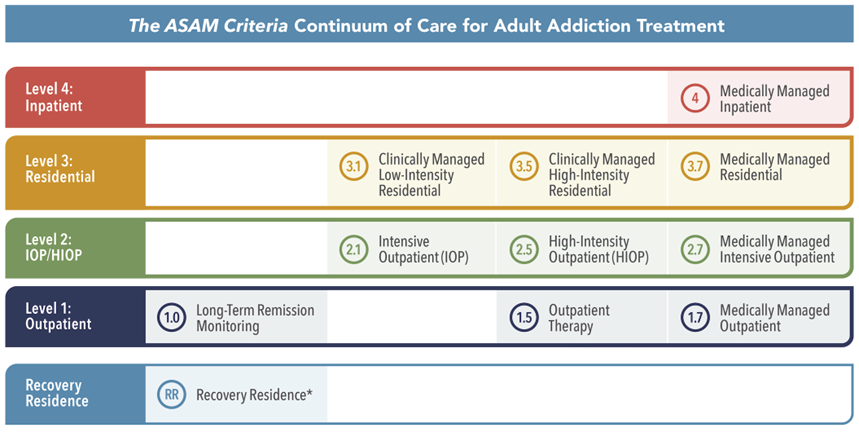
Updated Continuum of Care
The continuum of care has also been updated in the Fourth Edition. The continuum still includes four broad treatment levels (1 through 4). Within these four broad levels of care, decimal numbers express further gradations of intensity and types of care provided. Major changes include:
- Integration of medically managed levels of care—which provide medical management for intoxication, withdrawal management, and biomedical and psychiatric comorbidities—into the main continuum of care. The continuum also includes programs with enhanced biomedical capabilities (i.e., Level 3.7 BIO) to manage patients with medical comorbidities and enhanced capabilities to treat patients with co-occurring mental health conditions (i.e., co-occurring enhanced [COE] levels of care, which include Levels 1.5 COE, 1.7 COE, 2.5 COE, 2.7 COE, 3.5 COE, 3.7 COE, and 4 Psychiatric).
- A new Level 1.0 – Long-Term Remission Monitoring. This level of care provides long-term remission monitoring for patients in sustained remission, providing recovery management checkups and rapid reengagement in care when needed. This organization promotes a chronic care model of addiction treatment.
- The Dimensional Admission Criteria may recommend a recovery residence in addition to an outpatient level of care (i.e., Levels 1 and 2).
Medical Necessity Update and Reason
- Alignment across all national Ambetter markets
- Alignment of current continuum of care standards
- Decreased claims/billing issues
- Alignment with current addiction treatment medical necessity standards
- Provide clarity of treatment options for members
What this means for you
- For admissions on and after June 21, 2026, medical necessity review will be based on The ASAM Criteria, Fourth Edition.
- Please ensure clinical documentation supports the applicable ASAM dimensions and level-of-care recommendation.
- Continue to follow existing utilization management and authorization requirements unless otherwise communicated.
- If you have operational questions (e.g., documentation expectations or claims considerations), please contact Provider Relations or Provider Services using the information below.
Thank you for your continued participation and cooperation in our ongoing efforts to render quality health care to our members. We look forward to helping you provide the highest quality of care for our members.
If you have questions about this bulletin or other provider resources, please contact your Provider Relations Representative or call Provider Services at 1-844-518-9505 (TTY 711).
Ambetter from Sunflower Health Plan is underwritten by Celtic Insurance Company, which is a Qualified Health Plan issuer in the Kansas Health Insurance Marketplace. ©2026 Celtic Insurance Company. All rights reserved.
References
Waller, R. C. (2023). The ASAM criteria: Treatment criteria for addictive, substance-related, and co-occurring conditions (4th edition). Hazelden Publishing.